The Shadow
Jung's term for the disowned parts of the self — traits we deny and project onto others — which must be integrated to become whole.
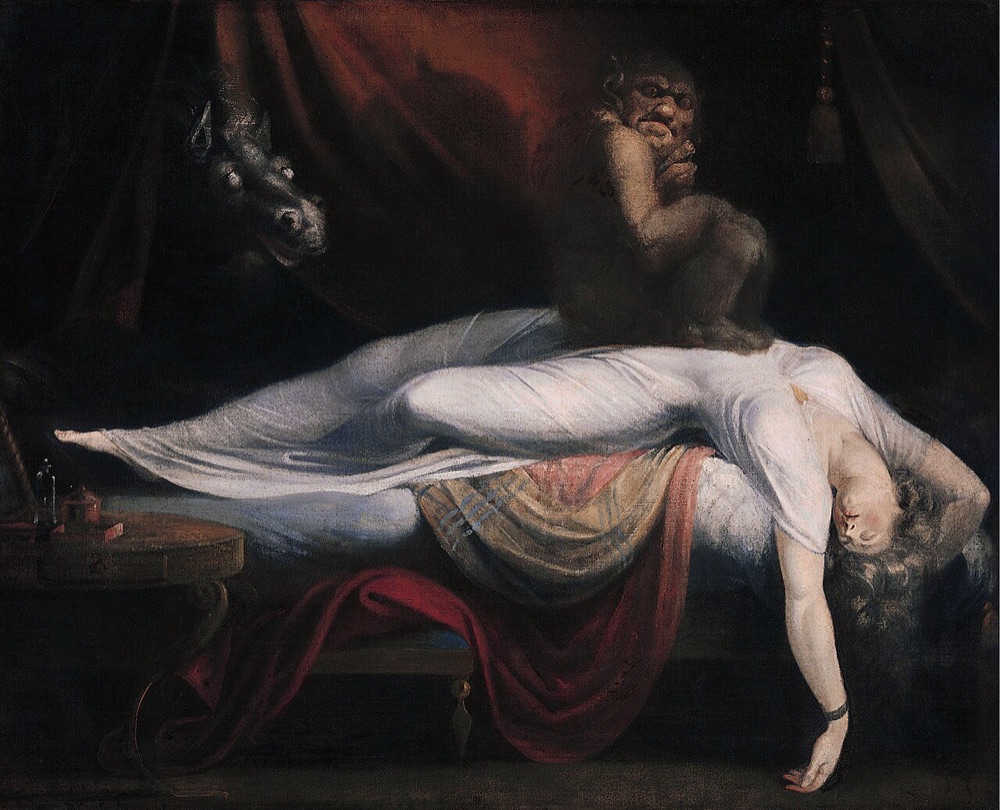
Fuseli sets a squat incubus atop the sleeper while a wild-eyed horse looms from the dark — the repressed, disowned underside of the psyche made flesh and pressing down on the self, the Jungian Shadow a century before Jung named it.
Henry Fuseli, The Nightmare (1781) · Public domain
What does the Shadow mean?
The Shadow is everything a person refuses to acknowledge about themselves: not only "negative" impulses but also unlived talents and desires. Because it is repressed, it tends to be projected — we see in others, and condemn, what we cannot face in ourselves. Jung argued that maturity (individuation) requires "making the darkness conscious" rather than defeating it. The aim is not to act out the Shadow but to know it, which paradoxically reduces its grip and recovers the energy locked inside it.
Maturity requires making the darkness conscious, not defeating it — you recover the energy locked inside.
How does the Shadow apply today?
- Understanding strong, irrational dislikes as possible projections
- A model for self-awareness work and depth-oriented therapy
- A caution against one-sided "positivity" that represses rather than integrates
The deeper point
The shadow’s trap is that you always meet it as a feeling about someone else. What you can’t stand in others is the most reliable map of what you’ve disowned in yourself — which is why projection, not introspection, is usually the first clue you’ve found it.
Quotes on this idea
- “Who looks outside, dreams; who looks inside, awakes.” — Carl Jung
- “He who fights with monsters should look to it that he himself does not become a monster. And if you gaze long into an abyss, the abyss also gazes into you.” — Friedrich Nietzsche
- “Until you make the unconscious conscious, it will direct your life and you will call it fate.” — Carl Jung
- “Everything that irritates us about others can lead us to an understanding of ourselves.” — Carl Jung
- “Knowing your own darkness is the best method for dealing with the darknesses of other people.” — Carl Jung
Compared in
Frequently asked
- What is the shadow in Jungian psychology?
- The unconscious part of the personality containing the traits we deny or repress. Jung held that confronting the shadow — rather than projecting it onto others — is essential to becoming whole.
- How do you integrate the shadow?
- By honestly recognising the disowned parts of yourself — envy, anger, ambition — and accepting them consciously instead of projecting them onto others. Jung called this process individuation.
- What happens if you ignore your shadow?
- Jung warned that repressed material does not disappear; it gets projected onto others or erupts unexpectedly. "Until you make the unconscious conscious, it will direct your life and you will call it fate."
Keep reading
Social proof
Seed the tip jar with a few coins and watch the crowd become the argument.
Go deeper
The book behind this idea: Man and His Symbols by Carl Jung. Hear the whole thing free — start an Audible trial and your first audiobook is on the house.
Read the full summary of Man and His Symbols →
More canonical picks:
- Thinking, Fast and Slow — Daniel Kahneman
- The Art of Thinking Clearly — Rolf Dobelli
- The Great Mental Models, Volume 1 — Shane Parrish
- Poor Charlie’s Almanack — Charlie Munger
- Super Thinking — Gabriel Weinberg & Lauren McCann
- Seeking Wisdom — Peter Bevelin
As an Amazon Associate, ReadGlobe earns from qualifying purchases and Audible trials — at no extra cost to you.
Cite this page
ReadGlobe. The Shadow. https://readglobe.com/idea/the-shadow/
"The Shadow." ReadGlobe, readglobe.com/idea/the-shadow/.
Primary source: Wikipedia
Summary based on Jung's collected works and standard secondary sources (Wikipedia, CC-BY-SA).