Reciprocity
Reciprocity is the deep social rule that we feel obliged to return what others give us — a favour, a gift, a concession. Receiving something creates a sense of debt we’re uncomfortable leaving unpaid.
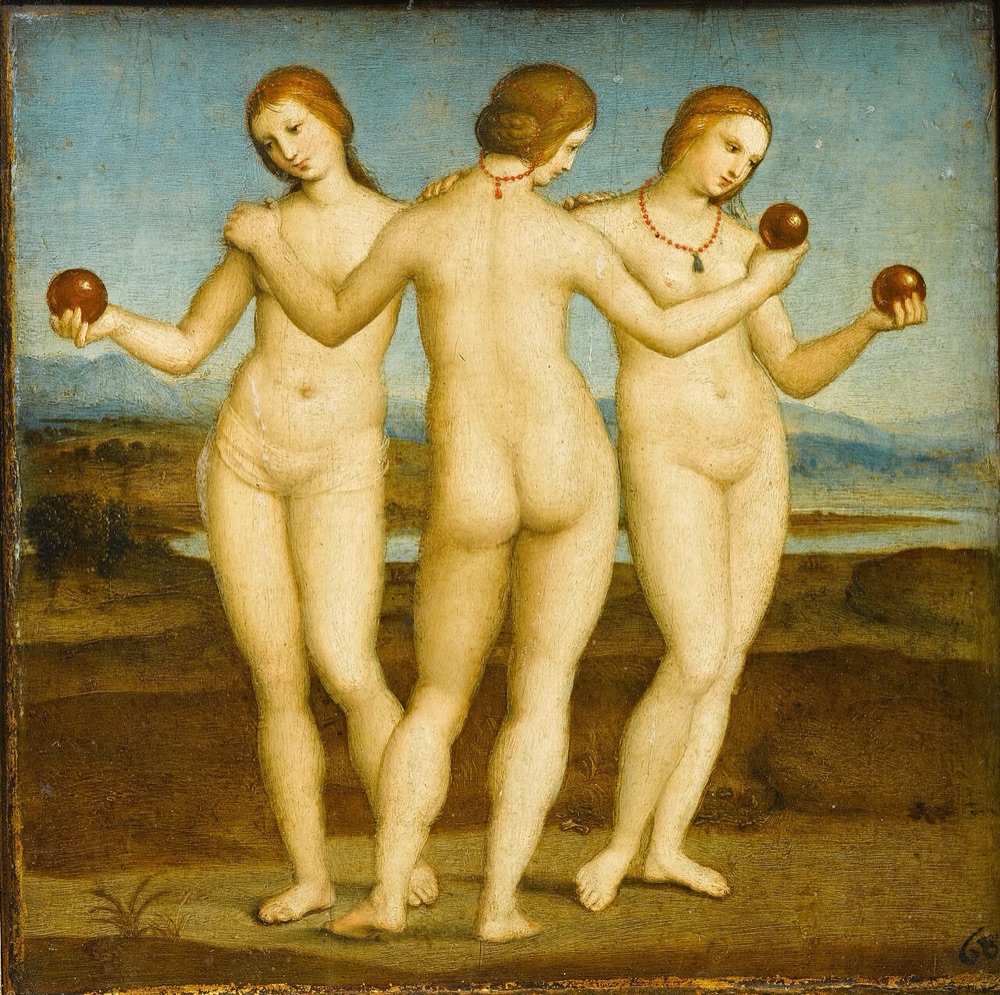
The classical emblem of reciprocity: three figures linked in a closed circle passing golden orbs, read since Seneca as the unbroken cycle of giving, receiving, and returning a benefit.
Raphael, The Three Graces (c. 1503–1505) · Public domain
How does reciprocity work?
The obligation triggers before we judge whether the gift was wanted or fair, which is what makes it powerful — and exploitable. A small unsolicited gift or a first concession shifts the other side toward giving something back.
Receiving something creates a sense of debt we're uncomfortable leaving unpaid.
How do you use reciprocity?
- Building relationships and trust: give genuine value first, without immediately keeping score.
- Negotiation: the “door-in-the-face” move — a large ask, then a concession, pulls a reciprocal concession from the other side.
- Spotting manipulation: notice when a “free” gift or favour is engineered to extract a disproportionate return.
What does reciprocity look like in practice?
A waiter who leaves a mint with the bill measurably increases tips; a charity that encloses free address labels lifts donations. The trivial gift creates a felt debt that people discharge with a far larger return.
Where does reciprocity fail?
Used cynically it’s a manipulation tactic, and the felt obligation can push people into lopsided exchanges. Reciprocity also has a dark twin — retaliation — where harms, not favours, get returned and escalate.
- The norm weakens in anonymous, one-shot exchanges — reciprocity assumes a relationship in which repayment can be observed and remembered.
- Unwanted gifts can trigger suspicion or resentment rather than obligation, especially when the recipient never asked and cannot refuse.
- The felt debt decays unevenly with time and is weighed differently across cultures, so a repayment one side sees as fair can insult the other.
The counter-model: Incentives — Before repaying a favour, incentives asks what the giver stands to gain — a gift can be an investment in your compliance.
How do you apply reciprocity, step by step?
- When you receive an unsolicited favour, gift, or concession, pause before responding.
- Name what was given and estimate what a proportional return would be.
- Ask what the giver stands to gain from your repayment.
- If the implied return exceeds the gift's value, decline or repay at the smaller, fair level.
Frequently asked
- What is the reciprocity principle?
- The social norm that people feel obliged to return a favour, gift, or concession they have received — often before judging whether it was wanted.
- Why is reciprocity so powerful in persuasion?
- Because the sense of obligation is automatic and uncomfortable to ignore, so a small first gift can elicit a disproportionately large return. Robert Cialdini documented it as a core principle of influence.
- What is the door-in-the-face technique?
- Making a large request that’s refused, then a smaller one — the “concession” triggers reciprocity, making the smaller ask more likely to be accepted.
Related
Keep reading
Hanlon’s razor
Malice is the expensive explanation; someone forgetting you is the cheap one.
See this alongside the other thinking tools of negotiation and persuasion & marketing.
Go deeper
The book behind this idea: Influence by Robert Cialdini. Hear the whole thing free — start an Audible trial and your first audiobook is on the house.
Read the full summary of Influence →
More canonical picks:
- Thinking, Fast and Slow — Daniel Kahneman
- The Art of Thinking Clearly — Rolf Dobelli
- The Great Mental Models, Volume 1 — Shane Parrish
- Poor Charlie’s Almanack — Charlie Munger
- Super Thinking — Gabriel Weinberg & Lauren McCann
- Seeking Wisdom — Peter Bevelin
As an Amazon Associate, ReadGlobe earns from qualifying purchases and Audible trials — at no extra cost to you.
Cite this page
ReadGlobe. (2026). Reciprocity. https://readglobe.com/model/reciprocity/
"Reciprocity." ReadGlobe, 30 June 2026, readglobe.com/model/reciprocity/.
Primary source: Wikipedia
Editorial synthesis © ReadGlobe 2026, drawing on the mental-models tradition (Charlie Munger, Farnam Street) and the primary sources for each model. · Last reviewed 2026-06-30.